
If you manage confined space entries, you already know the drill. Someone spots a job, a permit gets pulled, readings get taken, and if everything goes right, the crew goes home the same way they showed up. What trips people up is not usually the concept. It is the sequence, and how much of that sequence still lives on a clipboard that only one person can see at a time.
OSHA 1910.146 lays out a specific process for permit-required confined spaces, and it does not leave much room for interpretation. Here is what the five stages require, in the order OSHA expects them to happen.
1. Set up the space before anyone needs to enter it
Every confined space in your facility gets classified, permit-required or not, before a job ever comes up. That means documenting the known hazards for each space and setting the acceptable atmospheric thresholds for oxygen, LEL, CO, and H2S ahead of time. Do this once per space, correctly, and every future permit for that space starts from accurate information instead of someone's recollection of what it was like last time.
2. Issue the permit and authorize entry
When a job comes up, someone has to actually authorize it. That means reviewing the hazard assessment, confirming a rescue plan is in place, and verifying that lockout/tagout was completed by a specific, named person rather than simply checked off. This is also where paper systems come under pressure. If the person who needs to authorize the entry is on the other side of the plant, or at a different site entirely, the crew waits — and waiting is where the temptation to skip the step comes from.
3. Test the atmosphere, in the right order
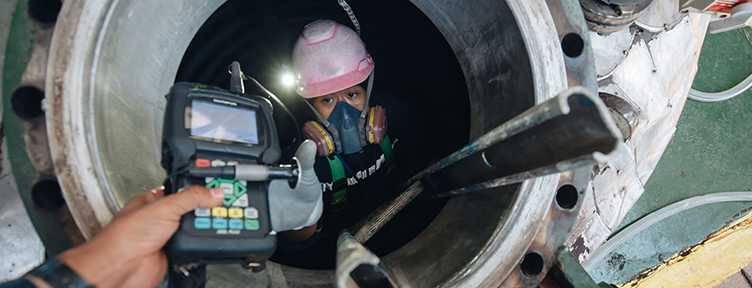
OSHA requires a specific testing sequence, and it is not arbitrary: oxygen first, then flammability, then toxics. Oxygen goes first because combustible gas sensors do not read accurately in an oxygen-deficient atmosphere, so testing out of order can return a reassuring LEL number in a space that is genuinely explosive. Initial readings happen before ventilation starts; clearance readings happen after. A permit should not unlock for entry until clearance readings pass the thresholds set in step one. On paper, nothing stops a reading from being written down out of order or after the fact. That is the exact gap a verified digital timestamp closes.
4. Monitor the entry while it is happening
Once workers are inside, someone has to track who is in and who is out, and atmospheric conditions need to keep getting logged for the duration of the entry. If something changes — an alarm sounds, nearby work starts, weather shifts — the entry supervisor needs to be able to suspend or cancel the permit immediately, not after walking back to the entry point to see what is going on.
5. Close it out and keep the record
Every permit, whether completed, suspended, or cancelled, needs to be archived and stay searchable. This is the step that matters most on the day an OSHA inspector arrives, or when your team sits down for the annual 1910.146 program review. The difference between pulling a specific permit from eight months ago in seconds and spending an afternoon in a binder usually comes down to whether that record was ever digitized in the first place.
None of these five steps are new. They are the same ones your crew already follows. What changes is whether the system around them catches a skipped step, a missing signature, or a reading logged out of sequence, or whether it simply trusts that everyone did it right. That is where paper permit systems tend to fail, usually not because anyone cut corners on purpose, but because a clipboard cannot enforce a sequence the way software can.
We are building PermitEdge with input from the safety managers and operators who run this process every day, and we are taking on early access users now. If you want a say in how it is built, and launch pricing that will not be around after we open publicly, join the waitlist.
For the companion piece on what the permit document itself has to contain, see The OSHA 1910.146 Permit Checklist.