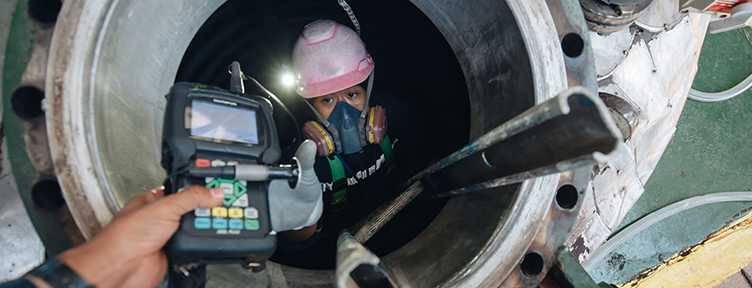

Most confined space citations are not exotic. They are not a mystery hazard nobody could have predicted. They are a permit that is missing a field.
OSHA 29 CFR 1910.146(f) spells out exactly what an entry permit has to identify before anyone goes in. It is a short section of the standard, and it is one of the first things an inspector will ask to see. If you want the surrounding workflow rather than the document itself, start with the five-step entry process. Here it is in plain language, with the places we most often see facilities come up short.
Print it, compare it against your current permit form, and see how you do.
The 15 required elements
1. The permit space to be entered. Not "Tank Farm." The specific space. If a facility has four tanks and the permit says "tank," the record cannot tell an inspector — or a rescue team — which one.
2. The purpose of the entry. What work is being performed. This matters more than it looks, because the task determines the hazards. Welding inside a vessel is a different permit than a visual inspection.
3. The date and the authorized duration of the entry. A permit with a start time and no authorized end is not a permit. It is a piece of paper. The authorized duration cannot exceed the time needed to complete the task.
4. The authorized entrants, by name or by another means that lets the attendant quickly and accurately determine who is inside. "Maintenance crew" does not satisfy this. If the attendant cannot answer "how many people are in there and who are they" in two seconds, the permit has failed its job.
5. The personnel serving as attendants. By name.
6. The individual serving as entry supervisor, with a space for the signature of the supervisor who originally authorized the entry. One named person, on the record, who authorized it.
7. The hazards of the permit space. Atmospheric, engulfment, configuration, mechanical, electrical, and any other recognized serious hazard.
8. The measures used to isolate the space and to eliminate or control hazards before entry. Lockout and tagout, blanking and blinding, misaligning or removing sections of lines, double block and bleed, purging, inerting, flushing, ventilating. This is the single most common gap we see. A checkbox marked "LOTO complete" with no attribution to a named person is a documentation gap waiting to be found.
9. The acceptable entry conditions. Written thresholds, not memory. For atmosphere, that generally means oxygen between 19.5% and 23.5%, flammable gases and vapors below 10% of the lower explosive limit, and toxic contaminants below their permissible exposure limits.
10. The results of initial and periodic tests, with the name or initials of the tester and an indication of when the tests were performed. The reading alone is not enough. Who took it, and when.
11. The rescue and emergency services that can be summoned, and the means for summoning them. "Call 911" is a plan only if you have actually confirmed that the responding department is equipped and trained for permit space rescue and can arrive in time. Many are not.
12. The communication procedures used by entrants and attendants to maintain contact during the entry.
13. The equipment to be provided. Testing equipment, communications equipment, personal protective equipment, lighting, barriers and shields, ladders and other entry and exit equipment, and rescue and emergency equipment.
14. Any other information needed to ensure employee safety for the specific circumstances of that space.
15. Any additional permits issued to authorize work in the space — hot work being the most common.
The completed permit must be made available to all authorized entrants at the time of entry, and the entry supervisor must terminate the permit when the work is finished or when a condition not allowed under the permit arises. Canceled permits are retained for at least one year for the annual program review.
The testing sequence people get wrong
Element 10 has an order to it, and the order is not arbitrary:
- Oxygen
- Flammable gases and vapors, as a percentage of the lower explosive limit
- Toxic air contaminants — carbon monoxide, hydrogen sulfide, and whatever else that specific space presents
Oxygen goes first because combustible gas sensors do not read accurately in an oxygen-deficient atmosphere. Testing out of order can produce a low LEL reading in a space that is genuinely explosive.
Two other things worth saying plainly. An oxygen reading above 23.5% is not "extra safe" — it is an oxygen-enriched atmosphere, a fire and explosion hazard, and a reason to evacuate, not to enter. And initial testing before ventilation tells you what the space actually contains; clearance testing after ventilation tells you whether it is safe now. You need both.
Where paper permits break down on this checklist
Look back at the 15 elements. Almost all of them are recordkeeping.
Paper handles the field for you. It does not handle the verification. Nothing on a clipboard stops a permit from being signed before the isolation is done, or a reading from being written down at 2:15 when the monitor was actually read at 1:40, or a permit from being filed in the wrong drawer and never found again.
That is the gap PermitEdge was built to close. The platform requires the testing sequence in the correct order, will not authorize a permit until lockout/tagout is verified and attributed to a named person, timestamps every reading and signature digitally, and stores every permit — completed, suspended, or cancelled — searchable by date range, location, and status. When the annual program review comes around, you pull the year in seconds. You can see how each element maps to a feature here.
If you want a deeper comparison of what actually changes on the floor, we wrote that up separately: Digital vs. Paper Confined Space Permits.
Use this before your next audit
Take your current permit form. Go down the list. Mark every element your form captures, every element it captures but does not verify, and every element it does not capture at all.
If you find gaps — and most facilities do — that is not a failure. That is a morning well spent.
PermitEdge is opening early access now. Join the waitlist for launch pricing and a say in the roadmap, or reach out to Mike directly if you would rather talk through your current process first.
This article summarizes federal OSHA requirements for general industry. Construction work is covered by a separate standard, 29 CFR 1926 Subpart AA, and some states operate their own OSHA-approved plans with additional requirements. Always verify against the standard as written and against your state plan.